The Impossible Winning Hand Fallacy

A Particular Kind of Bias
In the aftermath of the 2026 US Midterm Elections, the country had a moment to marvel at the outcome, take a collective breath, and then vibe up a narrative about why it happened. Theories range from a massive repudiation of the sitting president all the way to the mayor of New York being popular to... well... whatever this is?
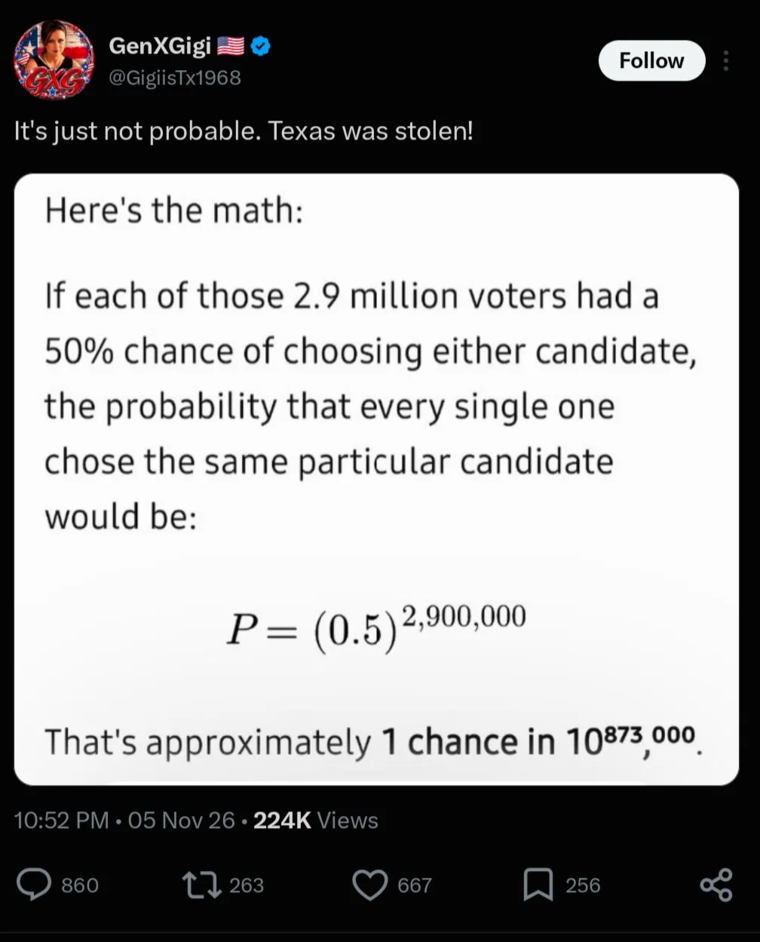
Yes, "this outcome is statistically impossible and here's why" is a common take among the more extreme in the right-wing faction. What's more, this kind of take is even familiar in these circles. An argument almost exactly like this underpins the DNA case for intelligent design, which says that the probability of a 100 base pair DNA strand is , pretty small!
I'm writing this post to tell you: this is a fallacy, and I'm calling it "the Impossible Winning Hand Fallacy". It's actually a peculiar intersection of two distinct cognitive phenomena, the equiprobable bias and the Texas Sharpshooter fallacy. When these two phenomena combine something subtler and more toxic is born. And the scariest thing about this new fallacy is that when you examine its individual components, everything seems grounded in basic mathematics and human intuition, but the answer comes up totally wrong.
Equiprobability
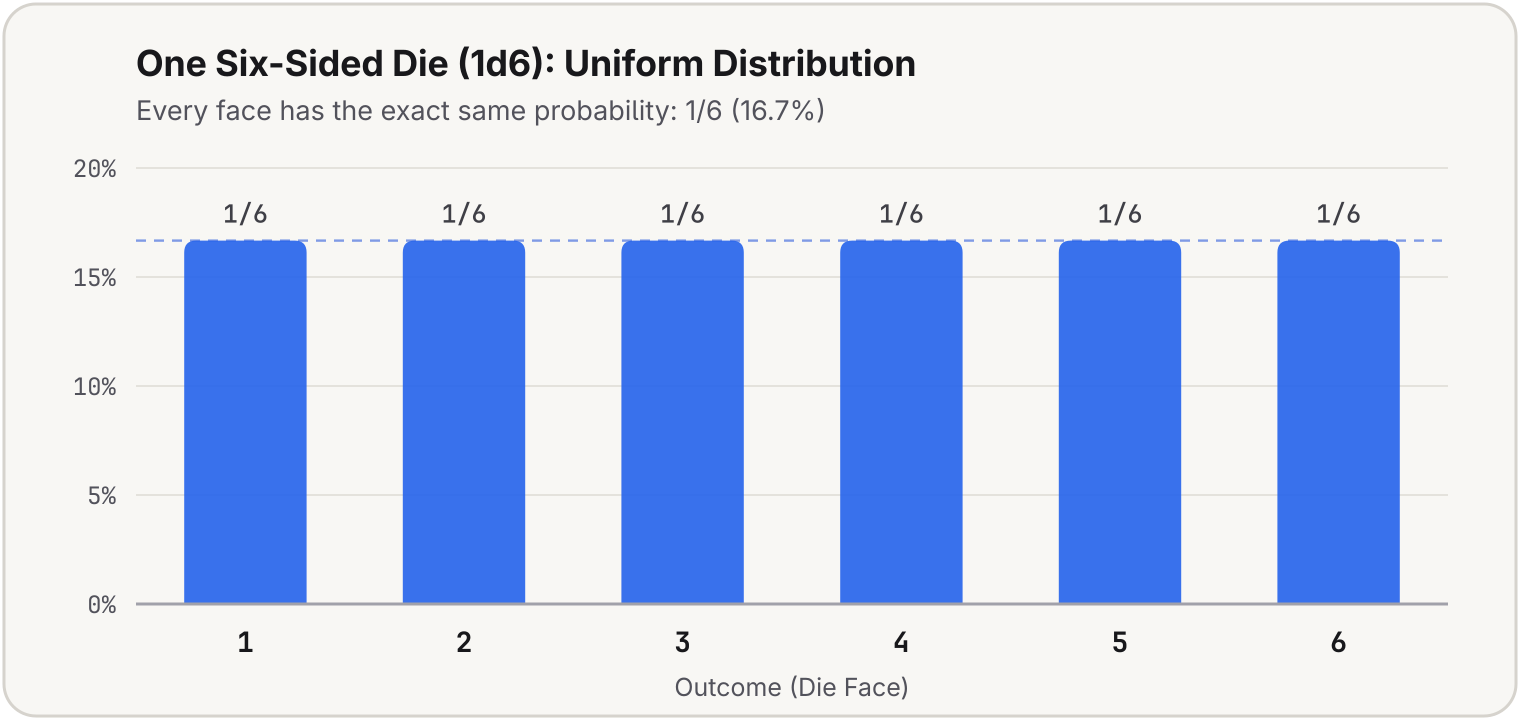
At the root of this fallacy is a correct intuition: "an unpredictable random outcome" is usually a uniform process. When we say "uniform" we mean that every single outcome in that process is equally likely. You're very familiar with equiprobable events because you've almost certainly rolled a fair six-sided die in your lifetime, and if you have you immediately have intuition for what we mean. So when we consider things like votes, it might be intuitive to imagine votes like a coin flip or a fair die. And maybe some people really do flip coins in the ballot box, but even if we did accept that, we can still find strange patterns in the results.
One of the most surprising things a novice in statistics learns is that when you combine uniform processes like dice rolls together, the results stop being uniform immediately. The process itself, along with the properties of numbers, can take a fair die and make bets unfair! A diagram can help make this clear, so let's consider our hypothetical fair die's result visually:
Now examine what happens if you take a copy of the same die and roll it. You can no longer roll a 1, and now you can roll up to a 12. But something else happens:
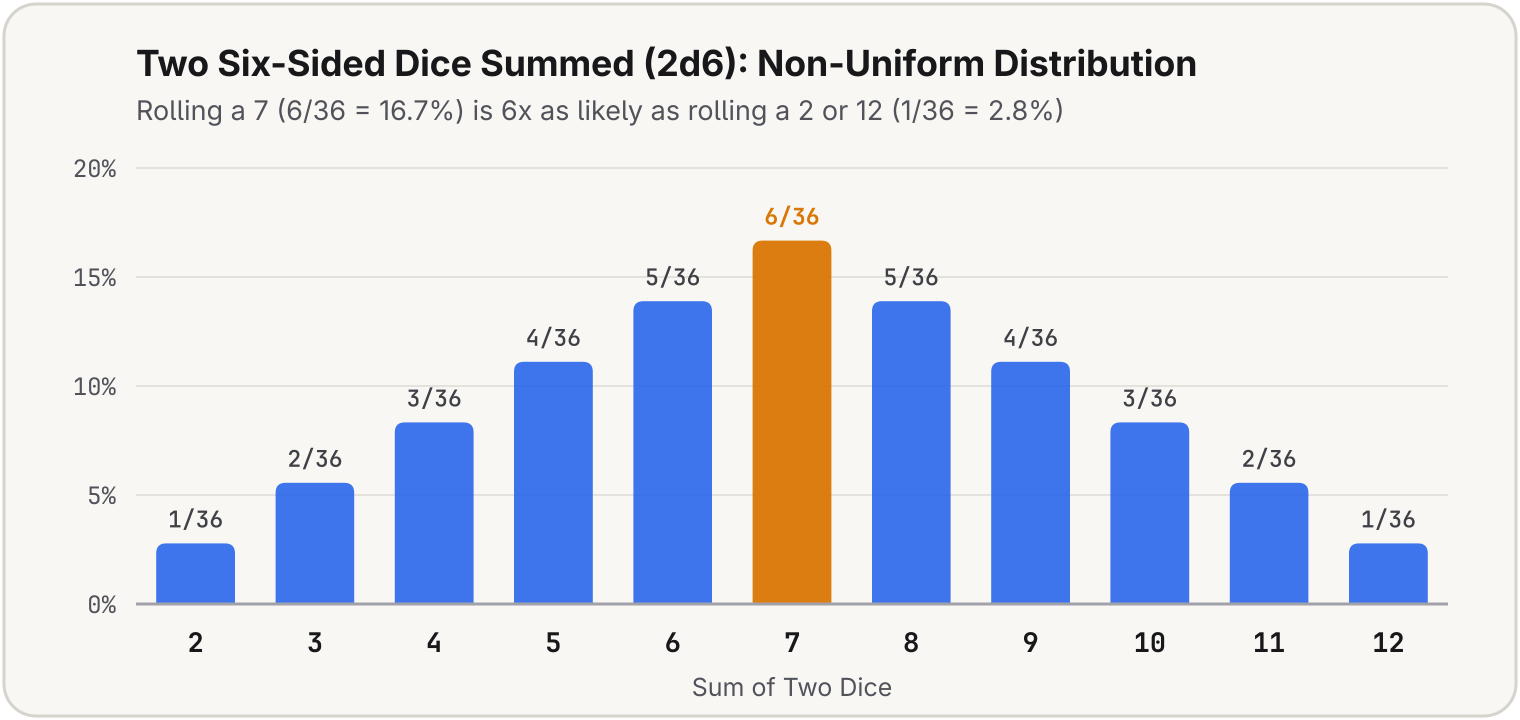
The process of adding these variables itself introduces non-uniformity!
The Equiprobable Bias
It turns out that people are bad at recognizing when this happens. It's a common enough failure mode that psychologists have studied the phenomenon, and they have a name for this mistake, "the equiprobable bias".
In this paper by Gauvrit & Morsanyi, they document the tendency of people to assume equiprobability even when complex processes combine together. Surprisingly, this assumption gets more common with a basic mathematical and even statistical education (along with age). That's because, G&M argue, it is rooted in true facts about probability. Uniform processes ARE common and many of the formulas you learn in introductory statistics and math assume independence and uniformity.
In the G&M study, many people even failed to recognize that a pair of rolled dice aren't uniform! And what's stranger is that even when people do know a pair of dice rolls a 7 more often than a 2 (say, anyone who's played craps or Settlers of Catan), they can still hold the contradiction in their head and assume complex processes like DNA recombination are uniformly random. Even educated people fall prey to this bias, and it takes a lot of careful didactic work and self-reflection to overcome it.
So let's restate it succinctly. The equiprobable bias occurs when someone:
- Tends to view a distribution as uniform when they have no reason to...
- Fails to see how when random processes combine they can become non-uniform.
Think back on our first examples. The election skeptic was assuming that voting is random, but is voting random? Do you vote randomly? No... we'd expect that people have reasons to vote and they might share those reasons (so their votes aren't independent, either). Similarly, does DNA recombine randomly? No, of course it doesn't! There are all sorts of complex biological processes at play, along with natural selection underpinning a process, that make DNA combine in non-uniform ways, but people can fail to recognize this fact even when they do recognize that 2d6 rolls more 7s.
The Impossible Winning Hand Fallacy begins with someone falling prey to this bias.
The Texas Sharpshooter Fallacy
Wikipedia's explanation of this famous fallacy is succinct and reasonable:
The Texas sharpshooter fallacy is the informal fallacy of focusing on evidence that supports a conclusion, while disregarding evidence that does not.
The name comes from a fictional sharpshooter who empties their pistol against the barn wall, finds the tightest cluster of shots, and draws a bulls-eye around that cluster after their pistol is empty. Importantly, the Texas Sharpshooter implies post-hoc model selection. The sharpshooter draws the target after they know where the bullets fall, which means they predict nothing. If you'd like to read more about the history of it, you can do so here.
In the case of our voting skeptic from above, you can see this thinking in play: "Look at all 2.9 million of these people voting blue, that's incredibly strange!" But look at what they actually did: they took only the 2.9 million people who voted blue, threw out everyone in Texas who voted red, and then asked what the odds were that all of the blue voters voted blue! They drew the target around a group of voters after seeing how they voted, applied a coin-flip model, and tried to suggest that the tiny number proves malfeasance. While it would be astronomically improbable for 2.9 million random people to march into the voting booth and all pick the same candidate by flipping coins, that's not actually what happened. What happened was millions more people walked in, some voted red, some voted blue, and a pattern emerged that favored one candidate.
The Texas Sharpshooter fallacy is very common, especially in a world saturated with data where it's difficult to spot cherrypicking data post-hoc in a never ending firehose of data.
Every Winning Hand Is Improbable Yet Inevitable
In poker, every hand played has at least one winner. The rules require it. But every deck of cards that is properly shuffled is almost guaranteed to be unique. Every given hand (and sequence of hands) has very low probability. Yet, we don't find it surprising that anyone wins a hand of poker, which means our intuition seems to be working. Let's build on that and consider an example in poker that's somewhat analogous to our examples above.
Imagine you're playing poker and you've just lost with a pair of fours. Your opponent took the hand with a royal flush. I think most people would say, "Well that makes sense. You lost with a bad hand to someone with an amazing hand." But let's take it through the lens of the fallacies above:
- Assuming an equiprobable bias, we'll conclude that every hand rank that beats us is equally as likely as those that do not.
- Assuming the Texas Sharpshooter fallacy, we're going to discard the fact that many hands would beat ours and instead focus on the fact that the opponent's hand is unlikely.
Both of these steps combine in a magical way: this reasoning works no matter what hand you lose to, even if your hand wasn't very good. And so you can use this pair of steps to conclude every opponent is always cheating. And the tricky part is: at no point are you saying something obviously false! Instead, you're discarding (and therefore failing to consider or mention) information.
We can easily tie this back to our "Specific DNA is rare therefore life is rare" example above. It is indeed the case that your specific DNA is improbable! But if we're considering the existence of beings that could exist, we need only consult the natural world to see a dizzying array of potential configurations. You might be improbable, but it seems that an incredible number of configurations of DNA produce living creatures. We shouldn't assume life is improbable just because we individually are improbable.
The Bayesian Approach
As with many cases where human intuition seems to lead us astray, a more rigorous approach can help us see exactly where our thinking goes wrong. In this case, the most useful tool is Bayesian math for comparing different hypotheses when considering a set of evidence. As we will see, the error we tend to make is striking when written out.
When we talk about "how likely is this state of affairs given my hypothesis" as a Bayesian we'd write it like this:
This is read as "the probability of the evidence (written ) given the hypothesis (written )." This simple formulation is quite powerful because it can be used in many ways. One particularly valuable way to use it is a "likelihood ratio." In this case, we'd want to consider the likelihood of our evidence given our hypothesis versus our hypothesis being wrong. We'd express that as a ratio:
This is written like a fraction, and it behaves like a fraction, so we can get some valuable intuition about how the probability will behave when the relationships are different.
| (Top) | (Bottom) | Likelihood Ratio | What It Tells Us |
|---|---|---|---|
| High | Low | (Large) | Strong evidence for (expected if is true, rare if not) |
| Low | High | (Tiny) | Strong evidence against (rare if is true, expected if not) |
| High | High | Uninformative, expected either way | |
| Low | Low | (if similar) | Uninformative, both are unlikely |
Suppose is the claim that something untoward has happened (cheating, rigging, etc), so is the ordinary, unrigged world. If you want to convince someone that is true, you need to land in that first row of the table (High / Low). Look at the table and think about how both of the phenomena we've named interact with the ratio to get you there:
- The Texas Sharpshooter rigs the top of the ratio () to look high. By deciding on your target after you already know the result, you can make your rigging theory look as likely as you want it to. But if you didn't also somehow rig the bottom then it would also look high, and the result would be High / High which is uninformative.
- The equiprobable bias rigs the bottom of the ratio () to look low. By pretending DNA base pairs or votes are distributed in a uniform way, you can make the bottom of the ratio extremely small. But without the Texas Sharpshooter acting on the top to make it high, the top of your ratio would also be small. That would leave you on the table at Low / Low, which is also uninformative.
So we see, both of these errors reinforce each other. And since they're both independently easy to commit, they're often found as a uniquely difficult-to-refute pair that confounds human intuition and can be really difficult to counter rhetorically.
Conclusions
The pairing of this bias and this fallacy is actually very common when you know to look for it. And when we look at how it interacts with the Bayesian math, you can see how the two mistakes act on different sides of the ratio, mutually reinforcing the desired outcome. Naming this combination "The Impossible Winning Hand Fallacy" helps ground the specific failures of reasoning into a whole, so people have a stronger grasp of how our intuition breaks down.
Maybe if we're armed with a better name, we can combat this bias more effectively. Maybe. I hope.